
By Drake Miller – Senior Content Manager and Academic Strategy Consultant
The Australian landscape is shifting. As we approach 2026, the “lucky country” is undergoing a digital transformation so profound that the traditional definition of literacy is being rewritten. For high school students, university leavers, and early-career professionals, the message from Industry 4.0 is clear: knowing how to “code” is no longer the ultimate finish line—it is the starting block.
While basic programming remains a fundamental tool, the 2026 job market demands a sophisticated blend of human-centric soft skills and high-level technical fluency. Many students balancing these evolving technical requirements with traditional coursework often seek assignment help for students to manage the transition effectively. To remain competitive in Sydney’s fintech hubs, Melbourne’s biotech labs, or Perth’s automated mining sectors, you need to look beyond the syntax of Python or Java.
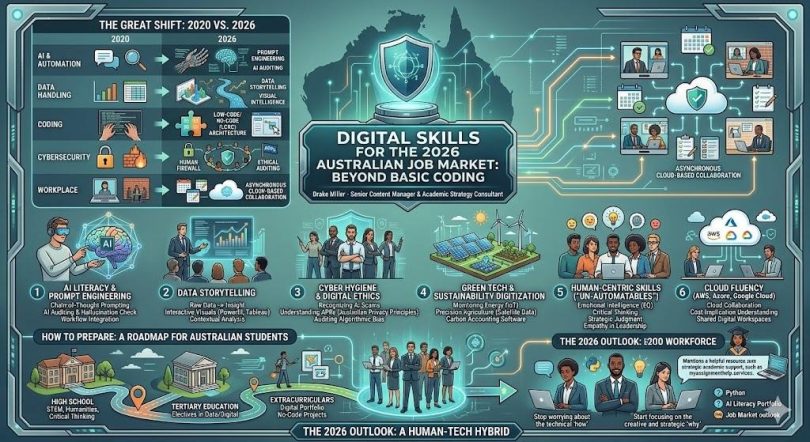
The Great Shift: 2020 vs. 2026
Before diving into the roadmap, it is essential to understand how the “required” toolkit has evolved over the last half-decade.
| Skill Category | 2020 Requirement (The “Old” Standard) | 2026 Requirement (The “New” Standard) |
| AI & Automation | Using AI for basic search/chat | Professional Prompt Engineering & AI Auditing |
| Data Handling | Basic Excel and data entry | Data Storytelling & Visual Intelligence |
| Coding | Writing manual syntax (Python/C++) | Low-Code/No-Code (LCNC) Architecture |
| Cybersecurity | Following IT department protocols | Being a “Human Firewall” & Ethical Auditing |
| Workplace | Physical office or standard Zoom calls | Asynchronous Cloud-based Collaboration |
1. AI Literacy and Prompt Engineering: The New “Microsoft Office”
By 2026, proficiency in Generative AI will be as mandatory as knowing how to send an email. However, the Australian market is moving away from casual “chatting” with AI toward professional Prompt Engineering.
For those studying in Queensland’s tech corridor, utilizing specialized online assignment help Brisbane can provide a practical edge in mastering these AI-driven workflows while staying on top of university deadlines. Employers are looking for individuals who can treat Large Language Models (LLMs) as highly skilled interns. This involves:
- Chain-of-Thought Prompting: Guiding AI through complex logic steps to ensure accuracy.
- AI Auditing: The ability to fact-check and identify “hallucinations” in AI-generated data—a critical skill for maintaining corporate integrity.
- Workflow Integration: Knowing which AI tool (Claude, Gemini, ChatGPT, or proprietary local systems) is best suited for a specific business task.
2. Data Storytelling: Making Numbers Speak
Australia is a data-driven economy. From the ASX 200 companies to local e-commerce startups, there is an ocean of data but a drought of insight. In 2026, “Data Literacy” isn’t just about reading a spreadsheet; it’s about Data Storytelling.
The market needs people who can take raw data from tools like PowerBI or Tableau and translate it into a narrative that a CEO can act upon. This requires visualization skills—creating intuitive, ethical, and non-misleading graphs—and contextual analysis to understand the “why” behind the “what.”
3. Cybersecurity Hygiene and Digital Ethics
With the high-profile data breaches seen in Australia over the past few years, cybersecurity is no longer just an IT department problem; it’s an “everyone” problem. In 2026, every Australian employee must be a “Human Firewall.” This includes recognizing sophisticated AI-generated phishing scams and understanding the Australian Privacy Principles (APPs). Furthermore, as algorithms begin to make decisions on hiring and lending, the ability to audit these systems for bias (Digital Ethics) will be a highly sought-after “soft-tech” skill.
4. The Rise of “Low-Code/No-Code” Development
While “Basic Coding” was the buzzword of 2020, 2026 is the era of the Citizen Developer. Businesses are increasingly using Low-Code/No-Code (LCNC) platforms like Microsoft Power Apps or Zapier to build internal tools without writing thousands of lines of code. Understanding the logic of software development—variables, triggers, and loops—is now more important than memorizing the specific syntax of a language.
5. Green Tech & Sustainability Digitization
A major growth sector for 2026 is the intersection of technology and sustainability. Australian industries are under pressure to reach Net Zero targets, leading to a demand for “Green Digital Skills.” This includes using IoT (Internet of Things) sensors to monitor energy consumption in manufacturing or using satellite data for precision agriculture in rural NSW and Queensland. Understanding carbon accounting software will soon be as relevant as financial accounting.
6. Human-Centric Skills: The “Un-Automatables”
As technical tasks are increasingly automated, “Human Skills” are skyrocketing in value. The National Skills Commission of Australia has consistently highlighted that the fastest-growing occupations require high levels of social interaction.
- Emotional Intelligence (EQ): The ability to lead with empathy.
- Critical Thinking: AI can provide information, but it cannot yet provide “wisdom.”
- Strategic Judgment: The ability to look at a failing system and identify the root cause through human intuition.
7. Cloud Fluency (AWS, Azure, and Google Cloud)
In 2026, the “hard drive” is a relic of the past. Almost every Australian enterprise operates in the cloud. You don’t need to be a Cloud Architect, but you do need Cloud Fluency—understanding how to collaborate on shared digital workspaces and the cost-implications of cloud computing.
8. Strategic Digital Self-Management
For those entering the gig economy or remote-first roles, Digital Self-Management is vital. This involves managing “technostress” and mastering tools like Slack, Trello, and Zoom for asynchronous project management.
How to Prepare: A Roadmap for Australian Students
The transition from high school to the workforce or higher education can be daunting. To bridge the gap, students should focus on a “T-Shaped” skill set: broad knowledge across many digital areas, with deep expertise in one.
- Year 10-12: Focus on STEM, but don’t neglect English and Humanities. These subjects build the critical thinking and communication skills needed to “talk” to AI and humans alike.
- Tertiary Education: Regardless of your major—be it Nursing, Law, or Construction—take an elective in Data Analytics or Digital Media.
- Extracurriculars: Build a digital portfolio. Instead of just saying you know how to code, show a project you built using a No-Code tool.
Balancing the acquisition of these 2026 digital skills alongside a heavy ATAR or university workload can be challenging. For many students, the pressure to maintain high grades while staying ahead of the technological curve is a significant stressor. Leveraging strategic academic support, such as Myassignmenthelp.services, can provide the necessary breathing room to focus on mastering AI prompting, green tech, and data storytelling without sacrificing academic performance.
The 2026 Outlook: A Human-Tech Hybrid
The Australian job market in 2026 won’t be dominated by robots. It will belong to the Hybrid Professional. This is someone who can navigate a complex dataset, prompt an AI to create a draft, and then use their human judgment to turn that draft into a strategy that resonates with the Australian public.
The “Beyond Basic Coding” era is an invitation to stop worrying about the technical “how” and start focusing on the creative and strategic “why.”
Frequently Asked Questions
Q.1 Do I still need to learn Python in 2026?
While not every role requires it, Python remains the backbone of AI development. It is better to understand its logic than to focus solely on memorizing syntax.
Q.2 How do I prove my “AI Literacy” to employers?
Build a portfolio. Show examples of how you have used AI to solve a problem, including the prompts you used and the auditing process you applied to the output.
Q.3 Is the Australian job market harder for graduates now?
It is more competitive regarding digital fluency, but there are more “Citizen Developer” roles available for those without traditional CS degrees.
About the Author
Drake Miller is a Senior Content Manager and Academic Strategy Consultant with over 12 years of experience in higher education and digital strategy. Based in London and Sydney, he specializes in the integration of Agentic AI and digital literacy within student workflows, helping the next generation of professionals navigate the evolving technological landscape of 2026.