

The modern academic landscape has transformed significantly over the last few years. Gone are the days when a notebook, a reliable pen, and a quiet library were the only tools required to excel. Today, the most successful students are those who treat their education like a high-level project management operation. They have realized that the volume of information they must process, analyze, and synthesize requires a sophisticated digital toolkit. By adopting new workflows, these high-achievers are not just saving time—they are fundamentally changing the quality of their academic output.
This shift toward efficiency is driven by the sheer pressure of modern coursework. Students are increasingly leveraging advanced software to organize their research, track complex deadlines, and streamline their drafting processes. For those facing extreme time constraints, MyAssignmentHelp provides specialized academic support, offering resources for students who might otherwise struggle to meet rigid deadlines, or even those who need assistance when they search for someone to take my online exam for me. This integration of technology and expert assistance allows learners to focus on mastering core concepts rather than getting buried in logistical hurdles.
The core of this digital shift lies in how students manage their data. Top performers have moved away from disorganized files and scattered notes. Instead, they are using platforms like Notion, Obsidian, and Zotero to build “second brains.” These tools allow them to link concepts across different subjects, creating a web of knowledge that makes writing essays and dissertations significantly faster. When you can instantly pull up your research notes from three months ago and connect them to a current thesis, the writing process becomes an exercise in synthesis rather than a frantic race against the clock.
This proactive approach to study also involves finding the right external resources. Many students now recognize that offloading certain repetitive tasks—such as formatting a massive research paper or structuring a difficult project—is a smart move.
The Role of Technology in Academic Workflow Management
Students today are dealing with more data points than ever before. To stay ahead, they are utilizing digital “stacks” that mimic professional project management environments. By centralizing all research, drafts, and administrative requirements, they create a friction-less environment for writing.
The Modern Student’s Digital Stack:
| Tool Category | Purpose | Recommended Tools |
| Knowledge Management | Organizing research and notes | Notion, Obsidian, Roam Research |
| Reference Management | Automating citations and bibliographies | Zotero, Mendeley, EndNote |
| Project Tracking | Managing deadlines and milestones | Trello, Asana, Todoist |
| Deep Work Focus | Blocking distractions during writing | Forest, Freedom, Cold Turkey |
The Rise of AI-Assisted Research and Structuring
Artificial intelligence has become the most debated, yet powerful, tool in the student’s arsenal. While some view AI with caution, top students use it as a force multiplier. They don’t use AI to write for them; they use it to brainstorm structures, clarify dense topics, and organize their bibliographies. By using AI as a research assistant, students can uncover gaps in their arguments before they even start writing the first draft. This ensures that their final submissions are not only technically sound but also intellectually rigorous.
Visualizing Complex Concepts for Better Retention
Another trend among top students is the use of visual mapping software. When faced with a complex theory or a multi-part assignment, they create flowcharts and decision matrices. Visuals act as a shortcut for the brain, allowing for faster processing of information.
The Academic Delegation Matrix
- High Urgency / High Complexity: Needs immediate deep work and expert focus.
- Low Urgency / High Complexity: Plan ahead; delegate structural research tasks.
- High Urgency / Low Complexity: Use automation tools to clear these quickly.
- Low Urgency / Low Complexity: Batch these tasks for efficient completion.
By applying this matrix, students prevent “analysis paralysis.” Instead of viewing every task as an equal mountain to climb, they categorize their workload and tackle it based on impact.
Tracking Progress with Agile Methodologies
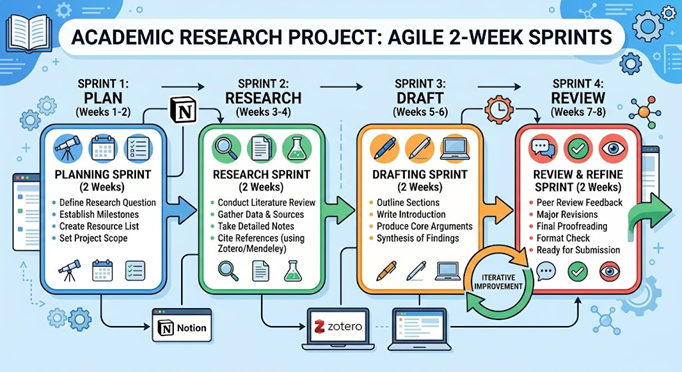
To effectively do my coursework online, students are increasingly adopting project management frameworks like Agile or Kanban. By breaking a long-term research project into two-week “sprints,” they ensure that they are never overwhelmed by the sheer scale of their work. They use digital boards to visualize their progress from the initial research phase to the final proofreading. This method provides a constant sense of accomplishment and keeps the student motivated throughout the semester.
Bridging the Gap Between Tech and Academic Integrity
Integrating technology does not mean ignoring the importance of academic integrity. On the contrary, these tools help students stay organized and transparent with their citations and research sources. By automating the bibliography and reference list, students avoid the common errors that often lead to academic penalties. The goal of this tech integration is to support the student’s learning process, ensuring that every hour spent studying is an hour spent effectively.
Maintaining Balance in a High-Performance World
Finally, the most important aspect of this digital revolution is the focus on mental well-being. By using productivity tools to automate the “busy work,” students gain more time for rest, physical activity, and social connection. A high-performance semester is not just about grades; it is about building a lifestyle that is sustainable in the long term. These tools serve as a safety net, ensuring that when the workload becomes unmanageable, the student has a system in place to keep moving forward.
Enhancing Critical Thinking Through Tool Selection
While tools are important, the student’s mindset remains the most critical factor. Productivity technology is only as good as the user’s ability to apply it to critical thinking. The best students use tools to offload the rote, mechanical aspects of writing—like formatting and basic data entry—so they can devote their mental energy to original arguments, innovative analysis, and unique conclusions.
Steps to Academic Productivity Success:
- Audit your current workflow: Identify where you lose the most time. Is it researching, drafting, or formatting?
- Select the right tool for the bottleneck: Don’t download everything. Choose one tool that fixes your biggest issue.
- Iterate and Refine: Evaluate your progress every few weeks. If a tool isn’t saving time, discard it.
- Integrate Expert Support: Recognize when the complexity of a task exceeds your current capacity and seek external professional help to ensure the final result is polished.
The Future of the Connected Learner
The gap between the average student and the top-tier student is becoming increasingly defined by how they manage their digital workspace. As we move further into the decade, those who embrace these productivity shifts will have a distinct advantage. They are not just completing their tasks; they are building a professional foundation that will serve them well beyond their graduation day. Technology is the catalyst, but the student’s strategy is the engine that drives success in every area of their academic career.
The ability to adapt to new technologies is no longer just a “nice-to-have” skill; it is a prerequisite for academic survival in a competitive environment. By combining the power of digital project management, AI-assisted research, and strategic collaboration with academic experts, students can transcend traditional barriers and achieve consistent, high-quality results. The students who thrive are those who understand that they are the architects of their own success, using every available tool to build a masterpiece out of their academic journey. As you move forward, remember that the goal is not to do more work, but to do better work, faster and with more clarity than ever before.
Frequently Asked Questions
How can digital tools help manage a heavy workload?
Digital tools allow you to centralize research, track project milestones, and automate administrative tasks, helping you stay organized and focused.
Is it better to use one app or multiple tools for study?
It is usually more effective to select a small, specialized “stack” of tools that address your specific bottlenecks rather than trying to use every available application.
How do project management methods apply to schoolwork?
Techniques like breaking large assignments into small, time-bound tasks help maintain consistent progress and prevent the stress of last-minute deadlines.
Can technology help improve the quality of my writing?
Yes, by using tools to handle formatting, citations, and structure, you can dedicate more mental energy to developing original arguments and critical analysis.
About The Author
Ruby Walker is a dedicated educator and curriculum development specialist who brings years of classroom experience to the team at MyAssignmentHelp. She is passionate about helping students achieve academic success through structured learning and effective study habits.